
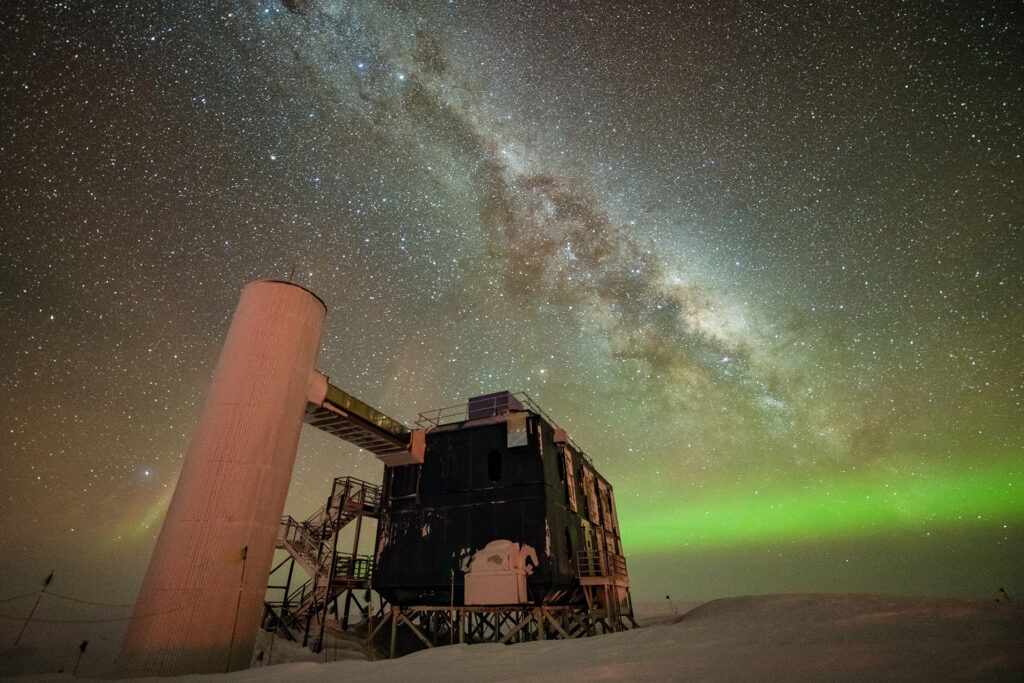
International collaboration tracking cosmic ghost particles at the South Pole
This year’s Nobel Prize in Physics was awarded to the particle researcher Francis Halzen for his research on neutrinos and his contribution to the IceCube neutrino observatory at the South Pole. Ever since the international research project was launched, a number of physicists from Friedrich-Alexander-Universität Erlangen-Nürnberg (FAU) have been involved. With other experts from across the globe, they have been working to track the elusive neutrinos and gain new insights into the origins of the universe.
The IceCube observatory is frozen deep inside the Antarctic ice. It is the ideal location to observe neutrinos: The mysterious particles are byproducts of nuclear reactions in the far reaches of the universe. They are virtually massless, carry no electrical charge, and only very rarely interact with matter. If it does come to such a collision, a flash of light is produced that provides information about distant regions of our universe. In this way, neutrino observatories around the world turn these ghostly particles into messengers. IceCube has emerged as a unique pioneer among these observatories, making discoveries that have not been made anywhere else.
FAU’s contribution to IceCube
FAU has been part of the IceCube collaboration for more than a decade. It has made a valuable contribution from the outset. For example:
- Researchers from FAU have developed methods to reconstruct traces of particles in the detector and to analyze data on neutrino flows.
- FAU has played an important role in calibrating the system and constructing innovative detector components that were integrated into the observatory at the South Pole as an IceCube upgrade only a few months ago.
- The working group from Erlangen is currently involved in analyzing high-energy particles from our Milky Way and in calibrating the optical properties of glacier ice.
FAU is making an important contribution to evaluate the data recorded by IceCube and to gain an improved understanding of the properties and origins of cosmic neutrinos. One of FAU’s unique features is its close connections to various different international neutrino telescopes, for instance the KM3NeT detector in the Mediterranean, the RNO-G experiment in Greenland and the new P-ONE experiment off the coast of Canada.
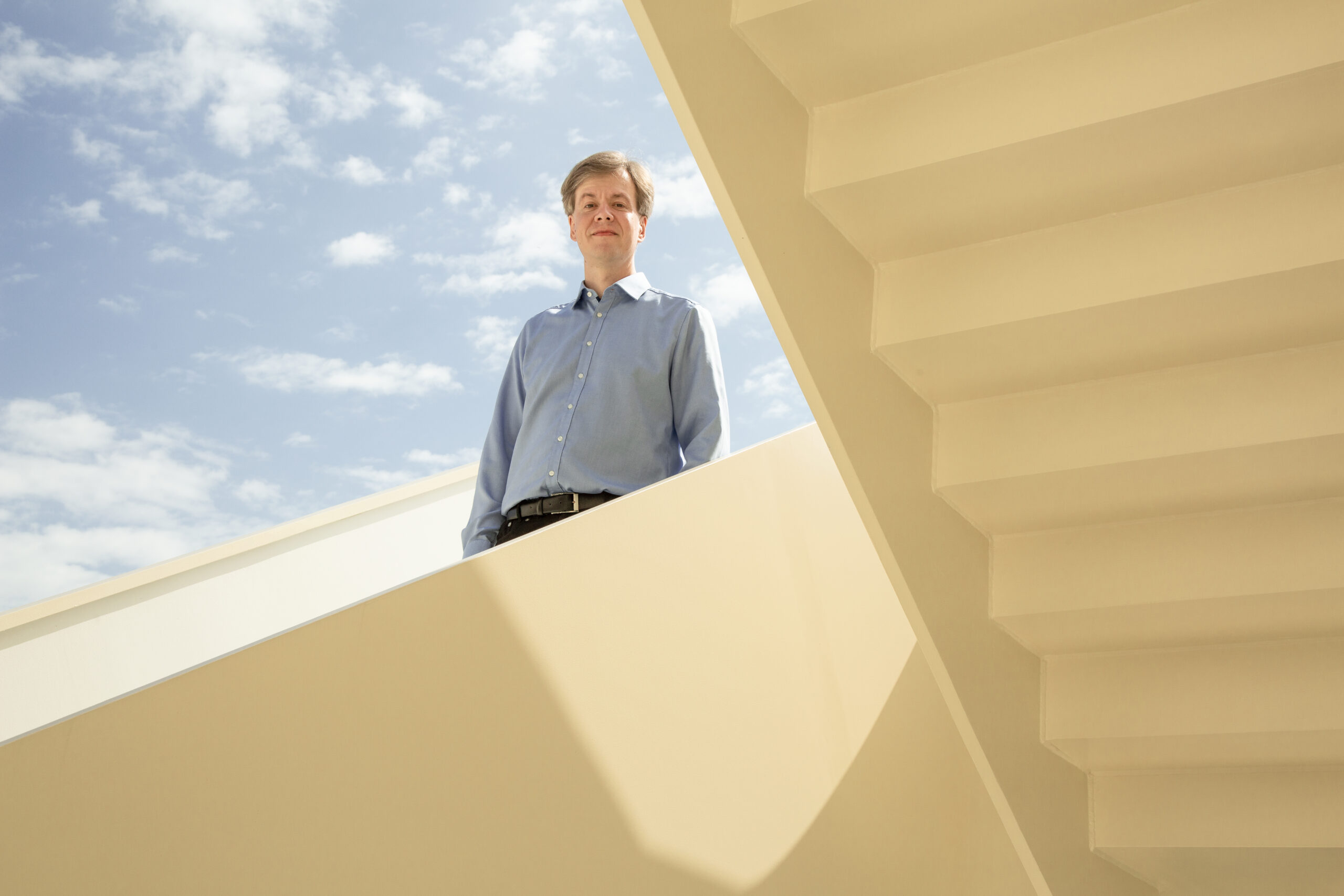
“From 2011 to 2014, I worked closely with Professor Halzen at the University of Wisconsin-Madison and made a major contribution to the discovery of the astrophysical neutrinos,” explains Dr. Claudio Kopper, who is now the Chair of Experimental Astroparticle Physics at FAU. “I am thrilled to see that our experiment, and neutrino astronomy as a whole, has now received such high-profile recognition. We have only just opened the door to this new field and hope that more data and new experiments will lead to further advancements in the coming decades.”
The award of the Nobel Prize underlines the significance of the international collaboration behind IceCube. For FAU, it is also recognition of the many years of research conducted by their researchers within the international collaboration.
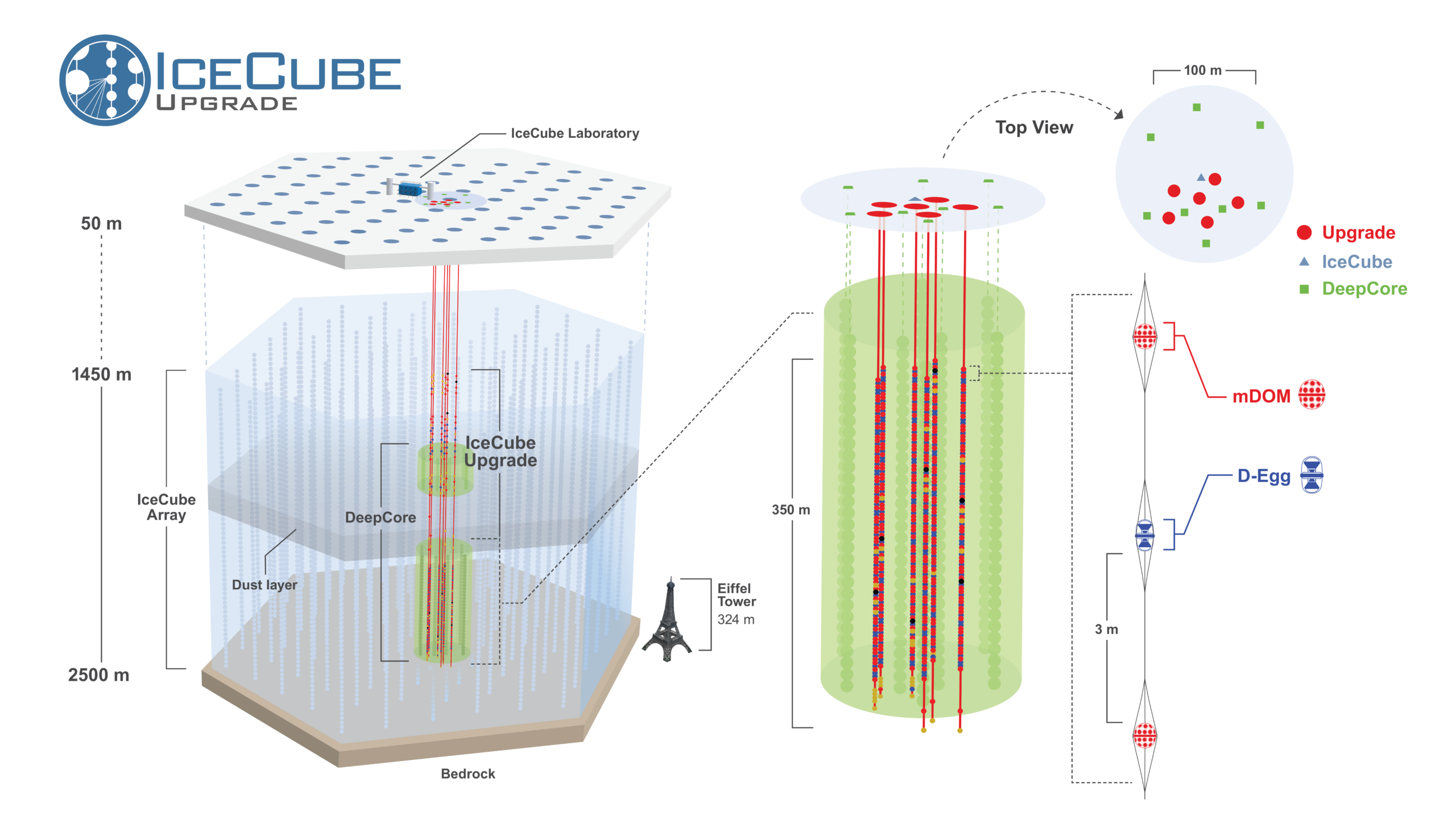
The IceCube upgrade consists of six new strings at the locations marked in red in the top view. The current IceCube array, optimized for TeV neutrinos, is shown in blue, while the existing low-energy extension called DeepCore is shown in green. The new module types mDOMs (red dots) and D-Eggs (blue dots) each contain several photosensors in each module. (IceCube Collaboration )2/32/3
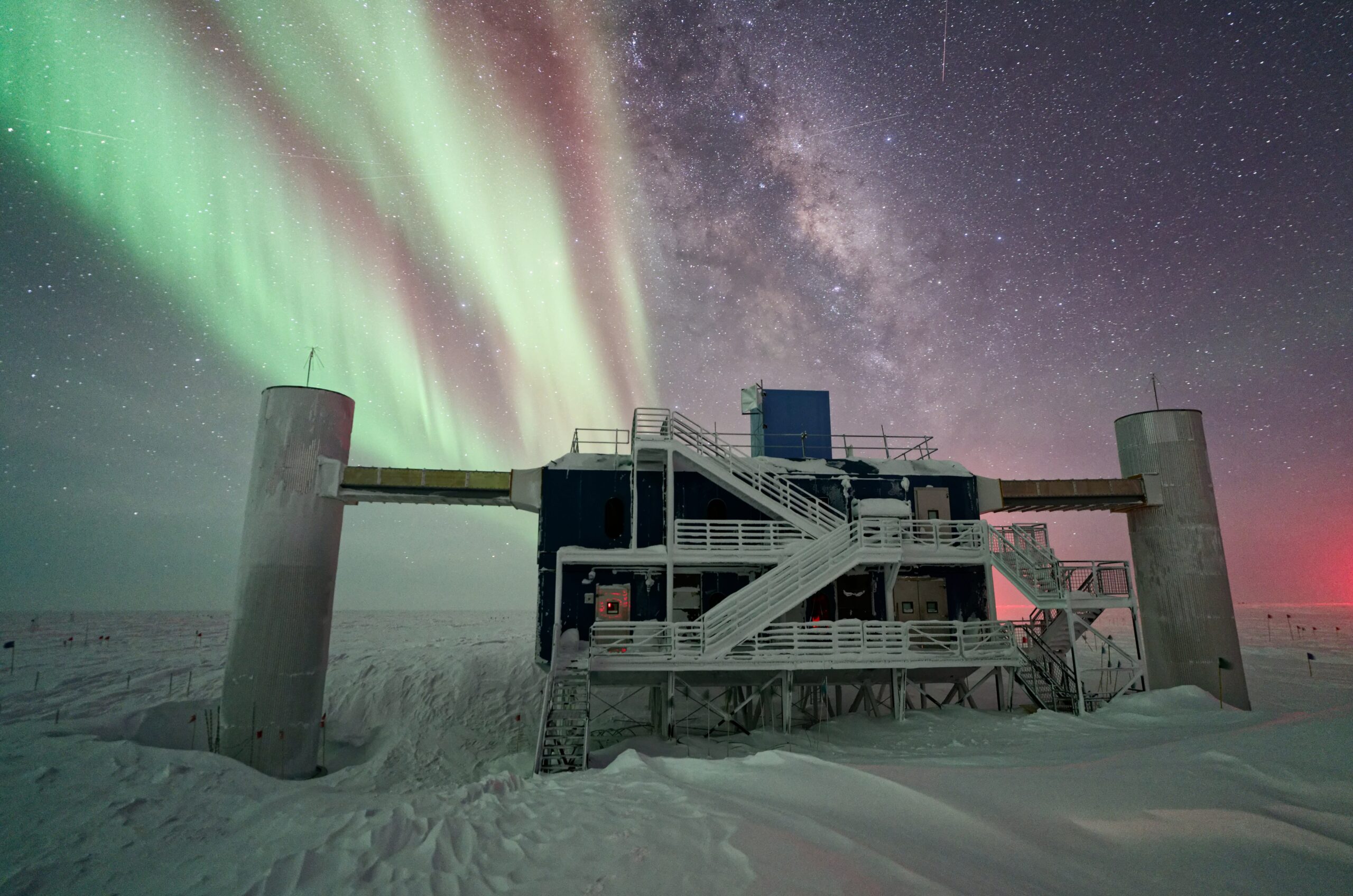
More about IceCube:
FAU website on IceCube: https://ecap.nat.fau.de/indexphp/research/neutrino-astronomy/icecube/
About the neutrino telescope and its upgrade in early 2026: https://www.fau.de/2026/02/news/hightech-unter-null-wie-die-fau-ein-teleskop-schaerfer-sehen-laesst/
Contact
Prof. Dr. Claudio Kopper
Chair of Experimental Astroparticle Physics